
AI-assisted educational draft published for Dr. Srikanth Munna, MBBS, DNB, MCh (Urology), consultant urologist and andrologist in Hyderabad. This page is general information. It is not a diagnosis or a personal treatment plan.
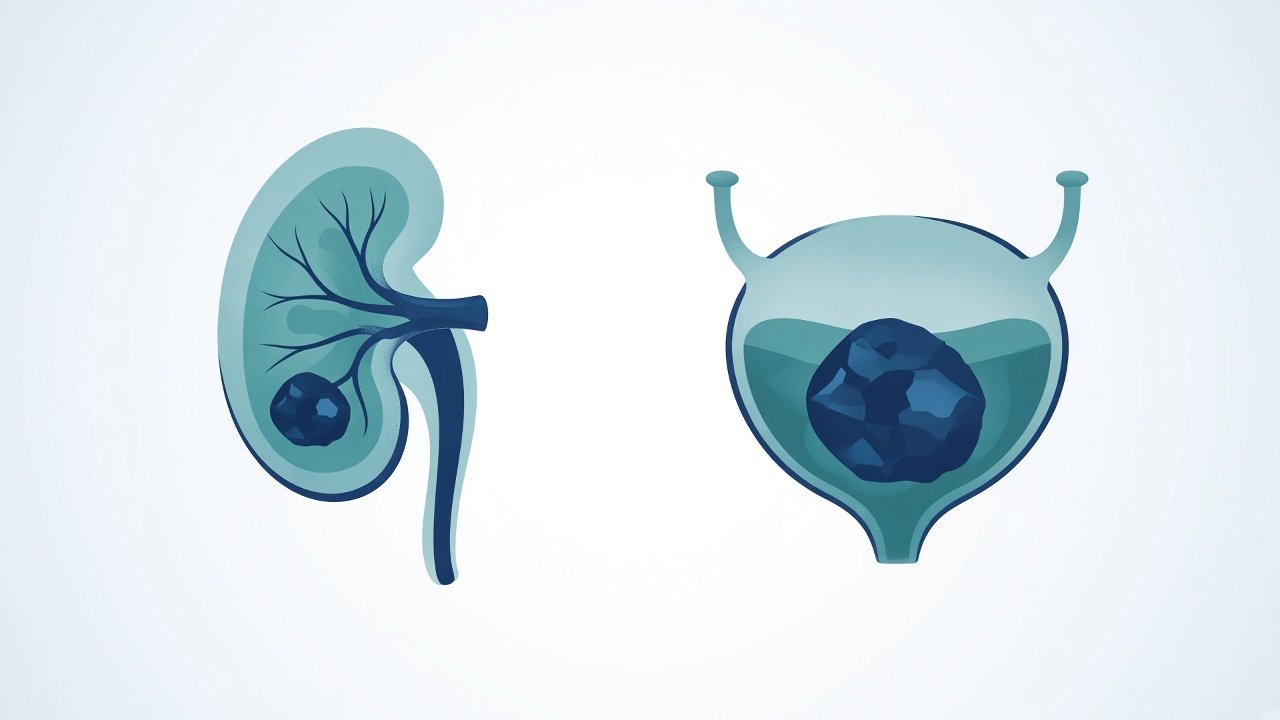
Kidney stones form in the kidney. Bladder stones form in the bladder, usually when urine sits too long, often because of prostate blockage, a stricture, a nerve problem, or a foreign body. Kidney-stone pain is typically in the side and comes in waves. Bladder-stone symptoms are more often pain at the end of urination, a stop-start stream, and blood. The treatments and the follow-up are different.
- Kidney stone. Forms in the kidney; pain is usually in the flank when it moves.
- Bladder stone. Forms in the bladder; often linked to poor emptying.
- Shared signs. Blood in the urine, frequency, and infection.
- Key follow-up. Find out why a bladder stone formed, or it may return.
How does a stone end up in the bladder?
Some small kidney stones pass down and reach the bladder. If they do not leave with urine, they can grow there. More often, bladder stones start in the bladder itself. Stagnant urine lets minerals settle. Chronic infection and a catheter or stitch that has worked its way into the bladder can act as a nidus.
In men, the common background is bladder outlet obstruction from an enlarged prostate or a urethral stricture. In children and in some adults, diet and chronic infection still matter in parts of the world. A stone is the result, not the whole disease.
How do the symptoms differ?
A moving kidney stone causes severe flank pain, nausea, and restlessness. The person often cannot find a comfortable position. A bladder stone more often causes pain toward the tip of the penis or at the end of the stream, interruption of flow, and a need to pass urine often. Position can change the symptoms because the stone moves inside the bladder.
Both can cause hematuria and infection. Neither pattern is perfect. Imaging is what separates them.
How are they found and treated?
Ultrasound sees many bladder stones and many kidney stones. CT is better for small ureteric stones. An X-ray shows some, but not all, stone types.
Kidney stones may pass, or they may need lithotripsy or a ureteroscopy. Bladder stones are usually broken and removed through the urethra with a scope, or through a small opening into the bladder if they are very large. At the same time, the reason for poor emptying is assessed. Removing the stone and leaving a tight prostate or stricture untreated raises the chance of another stone.
Can the same prevention advice be used for both?
Fluid intake matters for both. For kidney stones, salt and the stone type guide diet. For bladder stones, the priority is emptying the bladder: treating obstruction, reviewing constipation and medicines, and managing infection. A person can have both problems. The plan should say which stone was treated and what will stop the next one.
Questions people ask
Can a kidney stone become a bladder stone?
Yes. A stone that passes into the bladder and stays there can grow. Many bladder stones, though, form in the bladder from the start.
Do bladder stones always need an operation?
Most symptomatic bladder stones are removed. Medicines do not dissolve the common types reliably. The procedure is matched to stone size.
Will the stone come back?
It can, especially if the bladder still does not empty. Recurrence is a reason to treat the outlet problem, not only the stone.
Is the pain of a bladder stone the same as a urine infection?
Infection and bladder stones overlap. Burning and frequency occur in both. A stone is confirmed on imaging or at cystoscopy.
Related service page: Bladder stone removal.
Educational information only. Treatment decisions need an individual clinical assessment. Outcomes vary. This article does not claim results, rankings, or a guaranteed method of care.